Built for macOS · Lives in your menu bar
Your Mac controls the volume.
Volume Shield watches the exposure.
Volume Shield monitors your listening on macOS, estimates cumulative sound exposure, and warns you before loud sessions quietly become a habit.
macOS Sequoia 15 and later · Version 0.9.1-beta.1 · Estimates depend on your headphone profile and system audio.
The problem
A volume percentage is not a safety measurement.
Your Mac shows a number from 0 to 100. It does not tell you how loud that actually is at your ears — and 50% does not correspond to one universal sound level.
Different headphones produce different output at the same Mac volume. Risk depends on both loudness and duration: a level that feels fine for a few minutes can add up over a long session.
Hearing damage can accumulate without obvious pain or an immediate warning. By the time your ears feel different, the exposure has already happened.
What your Mac tells you
- Mac volume
- 62%
- What that means for your hearing
- Unknown
- Time listening
- 2 h 18 m
What Volume Shield adds
- Estimated level
- ~78 dBA
- Headphone profile
- Category estimate
- Seven-day exposure
- 41% used
Estimated using your headphone profile, output level, and audio activity — not a calibrated measurement.
Why it matters
The danger is not one loud moment. It is the exposure you stop noticing.
Loud listening often feels normal after a while. Your ears adapt to the sensation, but that does not make the exposure harmless. Hearing loss is frequently permanent — damaged sensory cells do not come back when you turn the volume down tomorrow. The useful time to act is before you notice a problem.
Over 1 billion
young adults are at risk of permanent, avoidable hearing loss due to unsafe listening practices.
World Health Organization10–40 million
U.S. adults under 70 have features on their hearing test that suggest hearing loss caused by loud noise.
NIDCD (U.S. National Institutes of Health)85 dBA
and above can cause hearing loss with long or repeated exposure — and the louder the sound, the less time it takes.
NIDCD (U.S. National Institutes of Health)
Sources: World Health Organization and the U.S. National Institute on Deafness and Other Communication Disorders (NIDCD). These figures describe population-level risk from unsafe listening. Not every headphone session causes hearing damage — risk depends on level and duration. Volume Shield is a personal-awareness tool, not medical advice; talk to a qualified professional about your hearing.
How it works
Four steps, then it stays out of your way.
- 1
Choose your headphones
Pick your brand and model. Volume Shield uses the most specific profile it has for that device and tells you how confident the estimate is.
- 2
Listen normally
The app runs quietly from the menu bar and reads the relevant audio and output information locally on your Mac.
- 3
See your exposure
A confusing mix of volume, signal level, headphone profile, and time becomes one clear status: on track, approaching, or over.
- 4
Act before it adds up
Get a warning after sustained loud listening — or let Volume Shield gradually lower the output. You stay in control the whole time.
One glance
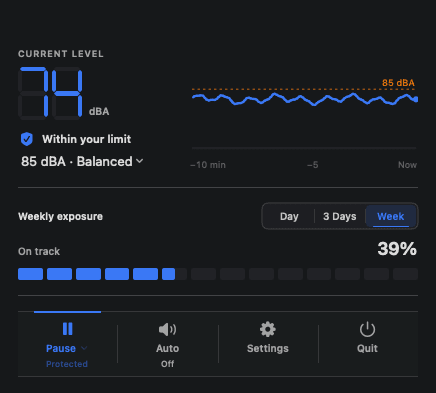
Green, amber, or red. That's the whole idea.
Open the menu bar and you see one status in plain language — no decibel math required. Volume Shield tracks how loud you've listened and for how long, then tells you where you stand.
Green
Within your selected exposure target. Keep listening.
Amber
Exposure is accumulating. A good moment to ease off.
Red
Sustained listening is above your target. Lower it or take a break.
Interface shown is representative. Levels and device names are illustrative estimates that depend on the selected headphone profile and your system audio.
Features
Enough to be useful. Nothing you have to manage.
Exposure, not just volume
Volume Shield weighs how long you listen, not one arbitrary volume percentage. A quiet-looking level can still add up over hours.
Headphone-aware estimates
Different headphones behave differently at the same setting. The app uses the best available profile for the device you selected.
Quiet menu bar monitoring
Check your current status from the menu bar without keeping another window open. It stays out of the way until it matters.
Warnings that arrive in time
You get a clear warning after sustained loud listening — not a stream of useless interruptions every time a track gets loud.
Optional gradual reduction
Let Volume Shield gently lower the output after sustained high exposure. It never raises the volume, and you can turn it off.
Local-first by design
Monitoring and history stay on your Mac. There is no account, no telemetry upload, and the app makes no network requests at runtime.
The difference
An extra layer of context, on top of the volume slider.
macOS gives you precise control over volume. Volume Shield adds the piece it was never meant to provide: what that volume means for your hearing, over time.
Without Volume Shield
- You see a volume percentage and nothing else
- No context for which headphones you're using
- No view of how exposure builds over time
- Easy to lose track of a long session
- You react only after discomfort or worry
With Volume Shield
- You see an estimated listening level in dBA
- The estimate accounts for your headphone profile
- Exposure accumulates on a rolling seven-day view
- A clear warning arrives after sustained loud listening
- Optional, gradual volume reduction you control
Accuracy & honesty
Useful estimates. Honest limitations.
Volume Shield estimates listening exposure from your Mac's audio activity, output level, and headphone profile. It is designed to help you make safer listening decisions — not to provide a clinical measurement.
Confidence varies by device, so the app tells you which kind of estimate it's using instead of hiding it. That disclosure is the point: you always know how much to trust the number.
It does not pretend every headphone can be measured perfectly through software, and it never substitutes a worst-case bound for an ordinary estimate.
Tested with this headphone model
A physical test on the identified hardware, with recorded device and macOS versions.
Based on manufacturer specifications
Applicable manufacturer maximum-output data, with provenance and stated uncertainty.
Based on independent measurements
Published independent acoustic measurements with a documented methodology.
Model-specific estimate
Defensible evidence for the specific model that is explicitly partial and bounded.
Estimated from similar headphones
A validated engineering estimate for the device's category when a model profile isn't available.
Broad conservative estimate
A universal headphone estimate used when even the category is uncertain.
Your hearing has to last longer than your headphones.
Install Volume Shield and give long listening sessions the context your volume slider was never meant to provide.
- Platform
- Native macOS
- Version
- 0.9.1-beta.1
- Requires
- macOS Sequoia 15+
- Install
- .dmg
Volume Shield is currently an invite-only private beta and is free during testing. Pricing has not been finalized. The download page explains how to request access.
FAQ
The questions worth answering first.
Straight answers about how the estimates work, what the app touches, and what it deliberately does not do. More detail lives on the support page.